
SSeeSY Stainless Steel Jewelry Passes EU REACH Testing — Lead, Cadmium & Nickel Release Compliant, Totally Skin-Safe
SSeeSY Stainless Steel Jewelry Passes EU REACH Testing — Lead, Cadmium & Nickel Release Compliant, Totally Skin-Safe
To sell jewelry in the European Union, every part that touches the skin must comply with REACH — the EU’s strict chemical regulation. SSeeSY sent finished rings to an independent third-party laboratory for the three REACH requirements that matter most for jewelry: lead, cadmium and nickel release. All three passed, with lead and cadmium not detected and nickel release below every applicable threshold. This page explains the rules, shows the evidence, and gives you the full report and Declaration of Conformity to download.
SSeeSY stainless steel jewelry has passed REACH testing — meaning the product fully satisfies the demanding requirements of the EU’s Registration, Evaluation, Authorisation and Restriction of Chemicals regulation. Every component in direct and prolonged contact with the skin complies with the key restricted substances: lead (Item 63 of Annex XVII), cadmium (Item 23) and nickel release (Item 27). The material is safe for long-term wear.
In plain terms: SSeeSY stainless steel jewelry is totally skin-safe, with no nickel allergy risks. Nickel is the most common cause of jewelry allergies — it is exactly the substance European regulators restrict most tightly, and exactly the one our material and plating system are built to avoid.
The tested rings were produced on SSeeSY’s own lines by Dongguan Songshan Trading Company Limited, the same legal entity behind our verified SGS factory audits, the 72-hour salt spray pass and the California Proposition 65 (CA65) compliance. One material system, four independent proofs.
Three REACH Requirements — Three Passes
Report No. RGST260921083 · issued 30 September 2026 by Shenzhen General Standard Testing Services Co., Ltd. (GST)
Total lead (Pb) — below detection limit of 10 mg/kg, against a REACH limit of 500 mg/kg
Total cadmium (Cd) — below detection limit of 5 mg/kg, against the 100 mg/kg limit for metal jewelry parts
Nickel release — below MDL of 0.05 μg/cm²/week in all 3 trials, against the 0.5 μg/cm²/week skin-contact limit
REACH Annex XVII items tested — all concluded PASS · DOC valid to 29 Sep 2027
The Full Report and DOC, Exactly As Issued
Two documents · the five-page test report and the one-page Declaration of Conformity
REACH Lead, Cadmium & Nickel Release Test Report — SSeeSY Stainless Steel Rings
Issued by Shenzhen General Standard Testing Services Co., Ltd. to SSeeSY’s legal entity Dongguan Songshan Trading Company Limited. Sample: rings (golden metal), tested 21–30 September 2026.
| Report No. | RGST260921083 |
| Lead (Pb) — Item 63 | N.D. — limit 500 mg/kg · Pass |
| Cadmium (Cd) — Item 23 | N.D. — limit 100 mg/kg (metal jewelry parts) · Pass |
| Nickel release — Item 27 | N.D. in all 3 trials — limit 0.5 μg/cm²/week · Pass |
| Issue date | 30 September 2026 |
REACH Declaration of Conformity (DOC) — SSeeSY Stainless Steel Rings
The official DOC confirming conformity with Item 63 (Lead), Item 23 (Cadmium) and Item 27 (Nickel release) of Annex XVII of REACH Regulation (EC) 1907/2006, signed by GST’s Technical Manager.
| Report No. | RGST260921083 |
| Sample | Rings · Country of Origin: China |
| Issue date | 30 September 2026 |
| Valid date | 29 September 2027 |
The EU’s Strictest Chemical Rules, Applied to Jewelry
REACH — the Registration, Evaluation, Authorisation and Restriction of Chemicals regulation — is the legal backbone of product chemical safety across the European Union. Its Annex XVII lists the substances that may not be used, or may only be used within strict limits, in consumer products.
For jewelry, three Annex XVII items matter most. Item 63 restricts lead in jewelry articles because lead absorbed even in small amounts accumulates in the body. Item 23 restricts cadmium, a heavy metal that must not be present in jewelry metal parts above 100 mg/kg. Item 27 restricts nickel release: nickel is the most common contact allergen in Europe, so any part coming into direct and prolonged contact with the skin may release at most 0.5 μg/cm² per week.
In this test, GST verified all three. Lead and cadmium were digested and measured by atomic absorption spectrophotometry (IEC 62321-5:2013), returning not-detected results. Nickel release was simulated with the standard wear-corrosion method EN 12472:2020 followed by chemical analysis per EN 1811:2023 on an ICP-OES instrument — three separate trials, all not detected.
N.D. = Not Detected (< MDL, Method Detection Limit). μg/cm²/week = microgram per square centimeter per week. Nickel release evaluated per EN 1811:2023 with the 46% uncertainty factor.
The Exact Sample That Was Tested
Specimen photograph reproduced from report RGST260921083 — a finished golden metal ring from SSeeSY production, photographed by the laboratory on its measuring stage.
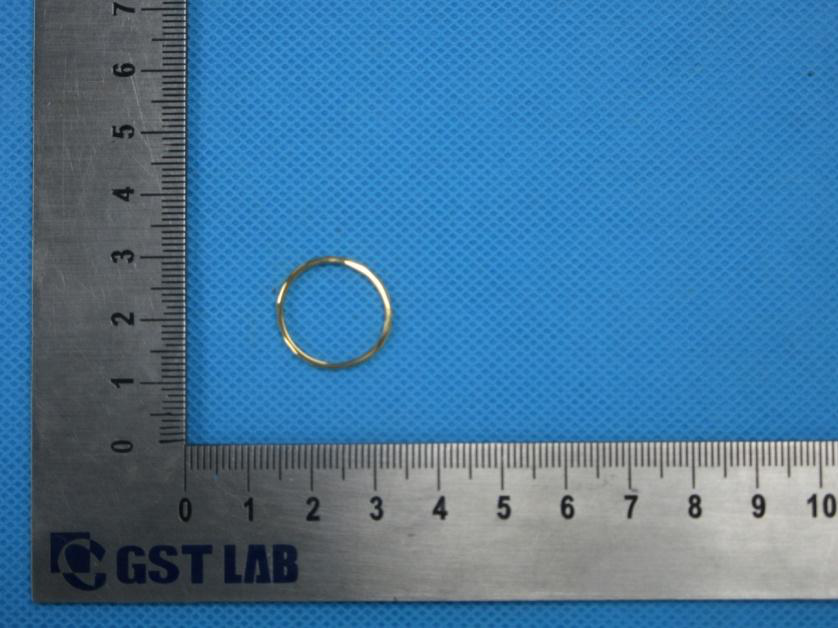
Specimen: rings (golden metal) · photographed at GST laboratory, September 2026
No Nickel Allergy Risks — What That Actually Means
If you have ever seen green marks or itchy red skin under a cheap ring, you have seen a nickel reaction. Nickel is the most common metal allergen in the world — and the one this report proves SSeeSY jewelry does not release.
Nickel allergy is a lifelong sensitivity: once it develops, even tiny amounts of nickel released from jewelry trigger contact dermatitis — itching, redness and irritation exactly where the metal touches the skin. That is why the EU’s REACH Item 27 limit exists, and why serious European retailers ask for EN 1811 nickel-release data before listing any jewelry.
SSeeSY’s result was not detected — three times in a row, under the standardized wear simulation. For your customers it means the jewelry can be worn all day, every day, without the fear of green skin or itchy ears. For your brand it means a compliance story you can put in writing.
Why SSeeSY Builds on Stainless Steel
REACH compliance is not an accident of one lucky sample. It follows directly from the base material SSeeSY chose for its entire collection.
Stainless steel is an iron-based alloy engineered for strength and corrosion resistance — it does not depend on lead or cadmium additives the way soft low-cost casting alloys do. And because the alloy matrix binds its metallic elements tightly, migration to the skin surface is extremely low — which is exactly what the nickel-release test measured.
Our PVD 18K gold plating is bonded to the surface in a vacuum process, without the chemical legacy issues of older plating systems. The same material system has now passed four independent proofs: factory audits, salt spray corrosion, California CA65 and European REACH. Whatever market you sell into, the paperwork already exists.
Stainless Steel Jewelry & REACH Testing FAQ
1. What is REACH?
REACH (Registration, Evaluation, Authorisation and Restriction of Chemicals) is the European Union regulation (EC) 1907/2006 governing chemical safety in all consumer products. Its Annex XVII sets binding restrictions on specific substances — for jewelry, the key items are lead (63), cadmium (23) and nickel release (27).
2. Which REACH requirements were tested on SSeeSY jewelry?
Finished rings (golden metal, adult jewelry, made in China) were tested for total lead content (Item 63, with amendment EU 2023/923), total cadmium content (Item 23) and nickel release (Item 27) — the three restrictions most relevant to jewelry in direct and prolonged skin contact.
3. What does “nickel release not detected” mean for allergy sufferers?
The sample was first aged to simulate years of wear and sweat (EN 12472:2020), then analyzed per EN 1811:2023. In all three trials the released nickel was below the method detection limit of 0.05 μg/cm²/week — far under the 0.5 μg/cm²/week limit for prolonged skin contact. That is the technical basis for saying: no nickel allergy risks.
4. Does this report cover all SSeeSY stainless steel jewelry?
The report applies to the tested ring sample, and the DOC is issued for that product category. Our collections share the same base material, plating process and audited production lines, so the result is representative of the material system — and category-specific REACH tests for your exact products can be arranged on request.
5. How can I verify the report?
The complete five-page test report and the one-page Declaration of Conformity can both be downloaded from this page, exactly as issued by GST laboratory. Report number RGST260921083, issue date 30 September 2026, DOC valid until 29 September 2027. Independent third-party re-testing is always welcome.
Want EU-compliant custom jewelry with real REACH documents?
SSeeSY is a custom stainless steel jewelry manufacturer with third-party proof for chemical safety, corrosion resistance and factory discipline — REACH, CA65, salt spray and SGS audit reports all available for your sourcing file. Tell us your designs, and we will handle materials, testing and production.