
Stainless Steel Jewelry Salt Spray Test | ASTM G85 AASS 72h Corrosion Report
Stainless Steel Jewelry Salt Spray Test | ASTM G85 AASS 72h Corrosion Report
Jewelry is worn against the skin, through workouts, on holidays and in every kind of weather — so “looks good in photos” is not enough. To prove how SSeeSY stainless steel jewelry performs in real life, we completed our stainless steel jewelry salt spray test, sending production samples to an independent third-party laboratory and exposed them to 72 hours of continuous hot, acidic salt fog. Every single specimen passed. This page explains the test, shows the evidence, and gives you the full report to download.
SSeeSY stainless steel jewelry has officially passed the ASTM G85-19 acetic acid salt spray test (AASS), one of the most demanding corrosion tests used in the metals industry. Our stainless steel jewelry salt spray test proves it resists tarnish from daily sweat, shower exposure and coastal humid environments, keeping its original polished shine without ugly rust spots even after long-term wear.
That laboratory result translates directly into everyday confidence: wear it to the office, to the gym, to the beach and into the desert — your SSeeSY pieces are built to stay bright, not to fade, flake or rust. If you have ever asked “does stainless steel jewelry rust?” or “will gold plated stainless steel jewelry fade in water?”, the stainless steel jewelry salt spray test below is our answer, verified by an independent lab.
The samples were produced on SSeeSY’s own lines by Dongguan Songshan Trading Company Limited — the same company and partner factory that passed on-site SGS audits in 2025 (see our SGS audit report article). Quality here is not a slogan; it is a paper trail.
72 Hours of Acidic Salt Fog — Zero Corrosion
Report No. RGST260921087 · issued 30 September 2026 by Shenzhen General Standard Testing Services Co., Ltd. (GST)
continuous acetic acid salt spray at 35±2°C
specimens passed — no obvious corrosion observed
acidified fog — far harsher than a neutral salt spray test
final verdict against the client requirement “no obvious corrosion”
The Full Test Report, Exactly As Issued
Six pages · test conditions, all 12 specimen verdicts and before/after photographs
ASTM G85-19 Acetic Acid Salt Spray Test (AASS) — SSeeSY Stainless Steel Jewelry
Issued by Shenzhen General Standard Testing Services Co., Ltd. to SSeeSY’s legal entity Dongguan Songshan Trading Company Limited. Four sample sets of finished jewelry (12 specimens in total) were tested between 22 and 28 September 2026.
| Report No. | RGST260921087 |
| Test standard | ASTM G85-19 — Acetic Acid-Salt Spray Test (AASS), Annex A1 |
| Spray duration | 72 hours continuous |
| Specimens | 12 (4 sample sets of SSeeSY stainless steel jewelry) |
| Pass criterion | No obvious corrosion after the test |
| Conclusion | PASS — all 12 specimens |
One of the Harshest Corrosion Tests in the Industry
A salt spray test does not just splash the samples with salty water. The specimens sit in a sealed chamber where a 5% saline solution is atomized into a hot fog that condenses on every surface, seam and edge — for three full days.
The ASTM G85-19 AASS method goes one step further than the common neutral salt spray test (ASTM B117): the fog is acidified to pH 3.1–3.3 with acetic acid. That acidic, chloride-rich environment attacks plating layers, coatings and base metals dramatically faster than ordinary rain, sweat or humidity ever could — which is exactly why it is used to evaluate automotive parts, fasteners and coated metals that must survive years outdoors.
For jewelry, the same chemistry is at work in real life: sweat is salty and slightly acidic, sea air is a constant salt mist, and humid summers keep moisture on the metal surface for hours. Passing 72 hours of a much stronger version of that attack is the laboratory’s way of saying the material and finish hold up where it counts.
Before and After 72 Hours of Salt Fog
Specimen photographs reproduced from report RGST260921087 — the same finished pieces, photographed before the test and immediately after 72 hours of acidic salt spray.
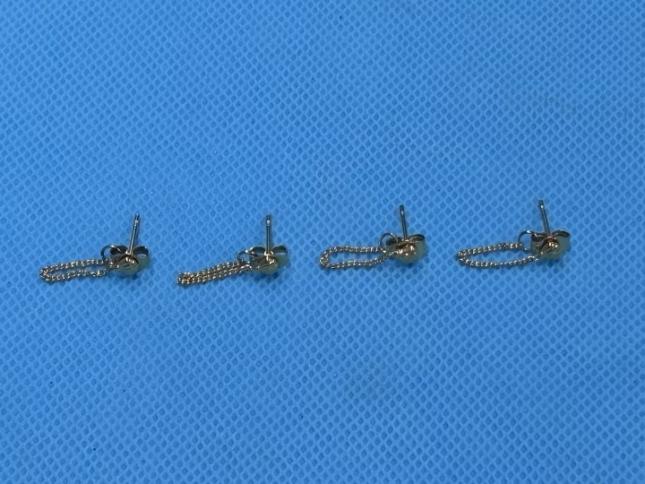
Before the test
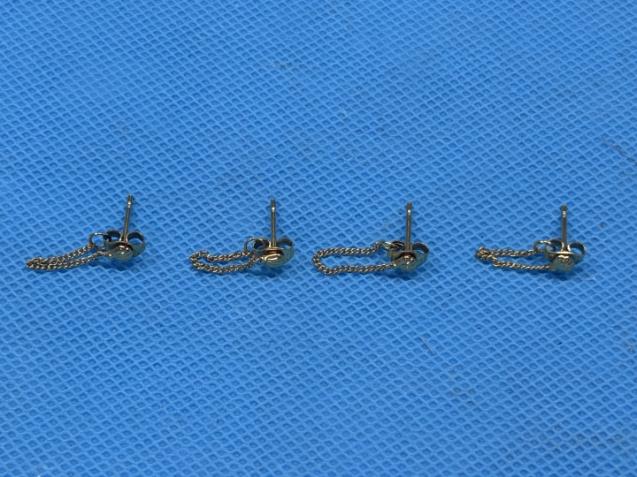
After 72 hours of acetic acid salt spray — surface unchanged, no rust, no pitting
Watch the Salt Fog Cycle in Motion
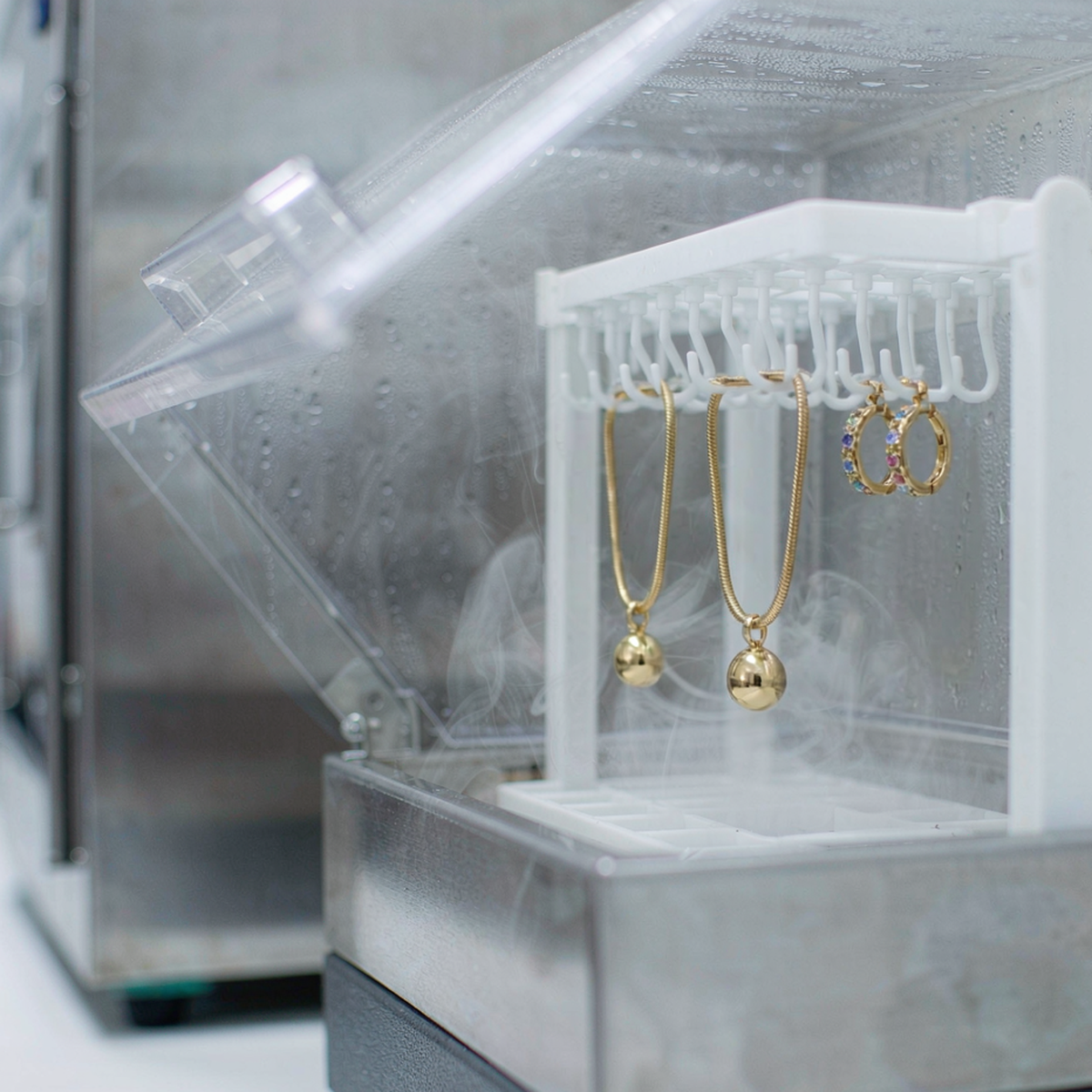
Footage from the chamber run reported in RGST260921087 — acidic salt fog circulating around the stainless steel specimens for the full 72 hours.
SSeeSY salt spray chamber running the ASTM G85 acetic acid salt spray (AASS) cycle
What a 72-Hour Salt Fog Pass Means for the Way You Actually Wear Jewelry
Everyday life throws milder versions of the same attack at your jewelry. Here is how the laboratory result maps to the places you actually wear it.
Everyday & Office Wear
Hand sweat, skin oils and long hours of contact are a mild, constant exposure. Jewelry that survives acidified salt fog shrugs off a full workday and an after-work shower without dulling.
Beach & Coastal Holidays
Sea spray is literally salt fog — the exact condition this test simulates, just at lower intensity. Wear your SSeeSY pieces seaside with confidence; a quick rinse in fresh water after swimming keeps the shine at its best.
Desert & Outdoor Travel
Dry heat and dust do not corrode metal, but sweat from activity does — and there is no ocean to rinse in. A corrosion-proof base metal means the piece you wear hiking comes home looking like the one you packed.
Gym, Sport & Daily Sweat
Sweat is salty and acidic — chemically similar to the test fog, just weaker. This is precisely the exposure the AASS pass is designed to cover, workout after workout.
Note: the test verifies corrosion resistance of the tested samples. Plated finishes, like all jewelry finishes, stay brightest with simple care — rinse after seawater or chlorine, and dry with a soft cloth.
Why SSeeSY Builds on Stainless Steel
Stainless steel forms a microscopic chromium-oxide layer that continuously protects the metal beneath — it is the same principle that makes marine hardware and surgical instruments corrosion resistant. Unlike fashion jewelry on a thin base of unknown alloy, a stainless steel body does not rely on plating alone to keep rust away: even if the surface is scratched, the metal underneath keeps protecting itself.
The tested samples included finished, gold-tone pieces from our regular production — and the photographs above show the surface and finish unchanged after 72 hours. Combined with our SGS-audited factory, 100% pre-shipment inspection and batch traceability, every SSeeSY order — from a 1-piece custom sample to a 200,000-piece monthly program — is made on the same lines as the samples in this report.
For brands and retailers, this is the practical meaning of “stainless steel jewelry”: fewer tarnish complaints, fewer returns, and product photos that still match the piece a customer receives two years later.
Stainless Steel Jewelry & Salt Spray Testing FAQ
Does stainless steel jewelry rust or tarnish?
Quality stainless steel jewelry resists both. In this test, 12 finished SSeeSY specimens were exposed to 72 hours of hot, acidic salt fog — a far harsher environment than sweat, shower steam or sea air — and no obvious corrosion was observed on any of them. The chromium in stainless steel forms a self-renewing protective layer, which is why the metal does not rust the way ordinary iron or low-grade alloys do.
What is the ASTM G85 acetic acid salt spray test (AASS)?
It is a standardized corrosion test defined in ASTM G85-19, in which samples are placed in a sealed chamber at 35±2°C and exposed to a continuously atomized 5% salt fog acidified to pH 3.1–3.3. Because the fog is acidic and chloride-rich, it attacks surfaces much faster than natural weathering, making it a trusted, accelerated way to compare corrosion resistance.
Can I wear SSeeSY stainless steel jewelry in the shower or at the beach?
Yes — that is exactly the appeal of the material. Shower steam, perspiration and coastal humidity are all far milder than the 72-hour acidified salt spray the jewelry passed. For best long-term shine, rinse the pieces in fresh water after swimming in the ocean or a pool and pat them dry.
Will gold-plated stainless steel jewelry fade?
All plated finishes wear eventually, but a stainless steel substrate dramatically slows the process because the base metal itself does not corrode or push discoloration through the plating. The gold-tone finished samples in this test came out of 72 hours of acidic salt fog with their surface unchanged. SSeeSY also offers PVD plating options for even harder-wearing color finishes on custom orders.
Is stainless steel jewelry suitable for daily wear and travel?
It is one of the most practical choices you can make: strong enough for daily and gym wear, corrosion resistant enough for beach holidays and humid climates, and light-maintenance by nature — no polishing cloths or storage rituals required. That combination of durability and low upkeep is why we built the SSeeSY line around stainless steel, brass, copper and 925 silver customization.
Which jewelry was tested, and how can I check the report?
Finished SSeeSY stainless steel jewelry from regular production — four sample sets, twelve specimens in total — tested by Shenzhen General Standard Testing Services Co., Ltd. (GST) between 22 and 28 September 2026 under report number RGST260921087. The complete six-page report, including all specimen verdicts and before/after photographs, is available for download above.
Want tarnish-free custom jewelry backed by real lab reports?
Send us your designs, samples or reference images. We will confirm materials, finishes, MOQ and lead time — and every program is produced on the same SGS-audited, salt-spray-tested lines you have just read about.